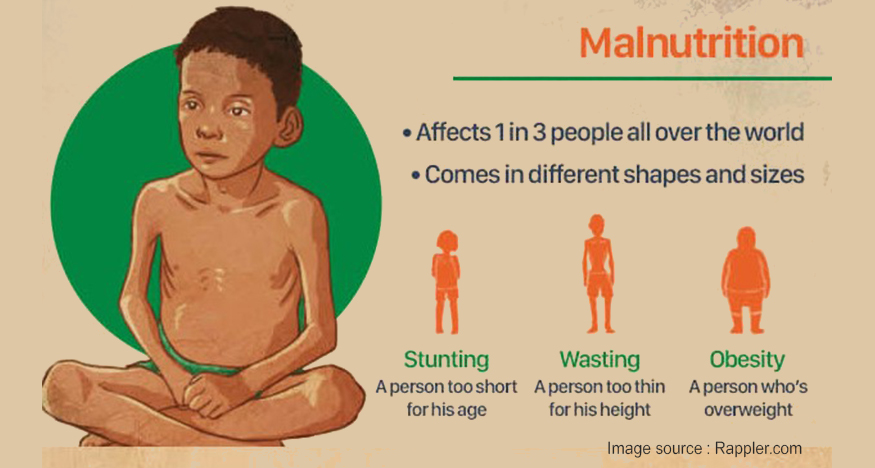
- Recognizing the magnitude of the malnutrition problem, and the kind of multi-level interventions required to provide a sustainable and holistic solution, Government of India tagged September 2019 as “Poshan Maah”, which translates to “Nutrition Month”. This welcome move underlines the concern that it is time malnutrition is confronted on a war footing by implementing a multi-pronged approach for its redressal.The target population of this initiative are children up to 6 years of age, adolescent girls and lactating mothers, with the initiative covering all states and UTs in a phased manner. There are specific targets for the reduction of low birth weight babies, stunted growth, incidences of Severe Acute Malnourishment (SAM) and anaemia. Information and Communication campaigns aimed at nutrition awareness at grassroots level forms an integral part of the programme, conducted with inclusive participation of stakeholders at various levels.The magnanimity of the malnutrition issue cannot be handled effectively by depending only on overarching government schemes, institutions and their limited capabilities. With the proportion of SAM-afflicted children much more than institutional facilities available to treat them, the Community-based Management of Acute Malnutrition (CMAM) approach comes across as a panacea to treat SAM and MAM children in community settings itself. This approach is indispensable to change the current trajectory of malnutrition in India for good. For families having the least access to nutrition-laden food, it is imperative to provide them locally produced RUTF formulations, medically proven to be effective in sustainably treating SAM.Malnutrition is not new to Indian society. Reeling with acute and severe malnutrition since independence, the National Family Health Survey (NFHS-4, 2015-16) shows a continually grim picture. Despite multitude efforts, SAM prevalence continues to rise among U5 children, with 7.5% afflicted with SAM in 2015-16. To treat this deep-entrenched, vicious problem of malnutrition, holistic solutions are an absolute necessity, which needs broad thinking rather than micro-management. In line with NITI Aayog’s ten-point action plan to tackle malnourishment, state-customized action plans have been emphasized to address local nutrition needs, rather than applying one-size-fits-all government schemes. This would, in turn, take account of ground realities and cause a substantial impact at the grassroots level.This necessitates a deep understanding of SAM, its magnitude, available treatment methodologies and their positive externalities. SAM is a medical condition which cannot be treated with the mere provision of food. It requires proper end-to-end management of RUTF – streamlining the preparation, distribution and use of accessible RUTF to treat SAM and MAM. RUTF provides an aggregate set of nutrients and caloric density for malnourished children. When prepared following the WHO and UNICEF guidelines, RUTF has been medically proven to be effective in decreasing incidence of SAM, quicker and cost-effective than traditional methodologies. Several pilot studies in India across varied settings is also a case in point to reinforce RUTF’s effectiveness. A concerted effort is thus required to close out existing knowledge gaps in nutrition space so that the scourge of malnutrition can be handled in an effective, accessible and sustainable manner using RUTFs.